

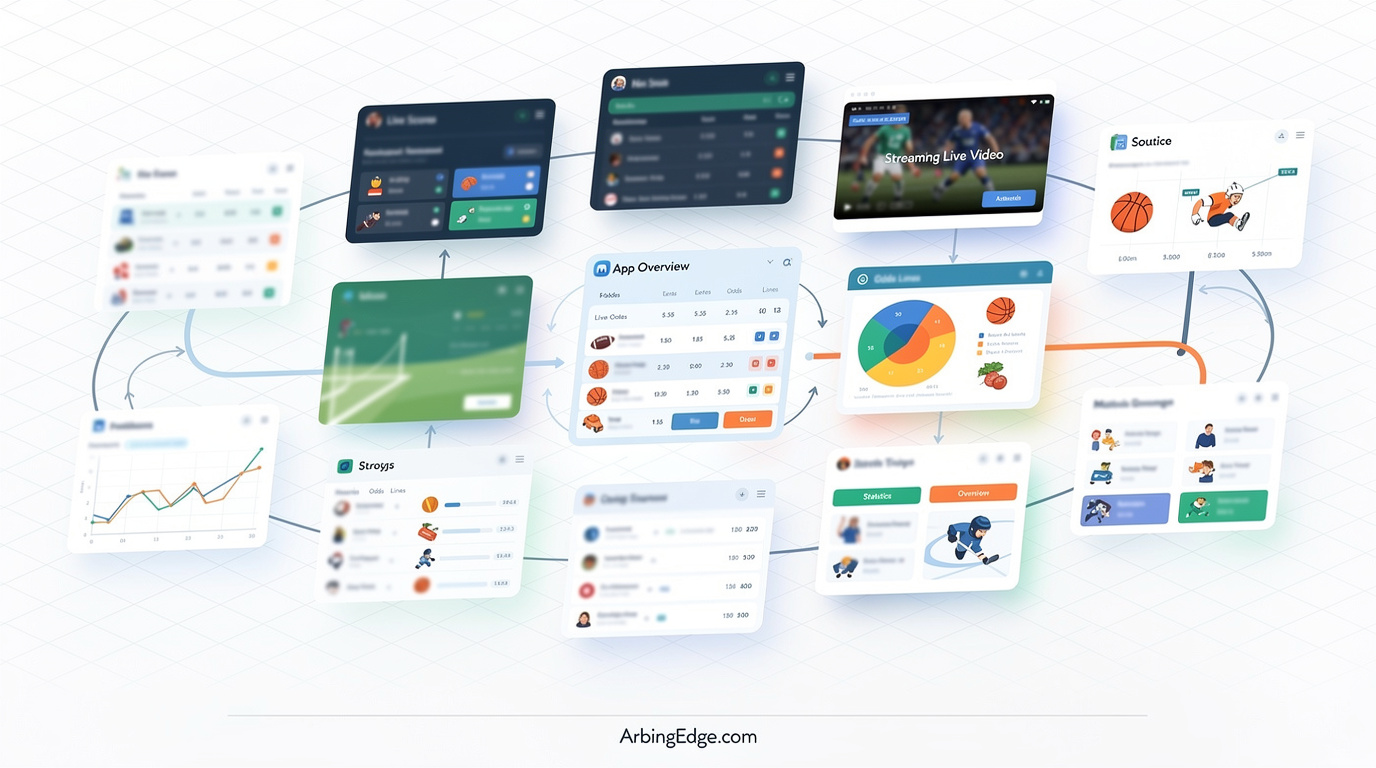
What data the US Sportsbooks Arbitrage API provides
Real-time arbitrage, positive EV, and raw odds across US sportsbooks
The feed mirrors the OddsJam web scanner. It streams live prices from 150+ sportsbooks (advertised by the provider, verified June 2026).
Coverage is built around US state-licensed books. Think DraftKings, FanDuel, BetMGM, Caesars, and ESPN BET rather than offshore operators.
The core data types you can pull:
- Arbitrage opportunities — two or more books pricing one outcome divergently enough to lock a guaranteed margin.
- Positive EV signals — single-book lines priced below the sharp market consensus.
- Raw odds — moneyline, spread, totals, player props, and alternate markets.
- Supporting data — injury reports, schedules, rankings, and live scores.
- Historical odds — a backtesting database for tuning filters.
Every record normalises to one event schema, so prices across books compare cleanly without custom mapping.
US Sportsbooks Arbitrage API data format and delivery
Structured JSON or XML, REST polling plus a real-time push stream
Responses are returned as structured JSON or XML (per the OddsJam odds-api page). The interface is REST over HTTPS.
There are two delivery modes to choose from:
- REST polling — request the arb or odds endpoint at your chosen interval and process the response.
- Push stream — a Server-Sent Events feed (
/api/v3/stream/odds/{sport}) pushes odds changes live, filterable by up to 5 sportsbooks per connection, league, market, andis_live.
Each arbitrage object carries the books involved, the odds at each book, the stake split, and the margin percentage.
It also includes the sport, league, event name, start time, and a unique opportunity ID.
Use that opportunity ID to deduplicate. Keep a local set of seen IDs and process only new entries on each cycle.
US Sportsbooks Arbitrage API pricing and the opportunity it unlocks
Sales-gated API pricing — weigh cost against monthly arb volume
OddsJam does not publish API pricing. Access is quoted through a sales conversation, and third-party API directories estimate enterprise access in the region of $500–$1,000+ per month depending on the sports, markets, and refresh rate you need (third-party reporting, June 2026). Pricing is custom and provided on request.
For reference, published consumer scanner plans run roughly $99–$499/month, with the historical database around $299/month.
Compare that cost against the opportunity, not against rival prices:
- $1,000 bankroll, 3 arbs/day, 2% average margin ≈ $1,800/month gross.
- Any subscription under ~10% of that gross is not the deciding factor.
- The real driver is actionable opportunity volume on the books you actually hold.
Decide on volume for your account portfolio, not the headline sticker price.
Integration and systems to build with the US Sportsbooks Arbitrage API
From a 60-second alert loop to an agentic pipeline
A minimum viable pipeline authenticates, polls the arb endpoint every 60 seconds, filters to your books and a minimum margin, and alerts you.
A developer comfortable with REST can ship that in 3–6 hours. Here are the systems this feed supports:
- Python alert bot — poll, filter by your books and min margin, push to Telegram or Slack. A community Python wrapper exists on PyPI.
- n8n / Make workflow — an HTTP Request node polls, a Function node filters, a Telegram node alerts. No server needed on n8n Cloud.
- Real-time stream consumer — subscribe to the SSE odds stream for live in-play monitoring.
- SaaS alert product — build subscriber UI and per-user book config on top of the raw signal layer (subject to terms of service).
Note on placement: no US book offers a placement API, so build a manual-confirm step where you place each leg yourself.
See the done-for-you setup service if you want a working pipeline without building from scratch.
US Sportsbooks Arbitrage API pros and cons
Honest assessment for developers evaluating this feed
- Only US-market arbitrage API built specifically for state-licensed sportsbooks
- Includes positive EV signals alongside guaranteed arbs — two signal types from one subscription
- Historical odds endpoint for backtesting filtering parameters
- JSON or XML, plus a real-time SSE push stream for live data
- No international bookmaker coverage — irrelevant for non-US bettors
- No automated placement API for US sportsbooks (no US operator provides one)
- API pricing is sales-gated — no public number without a sales call
- Rate limits on live data restrict high-frequency polling
US Sportsbooks Arbitrage API Access
Test the live US sportsbook arb feed and positive EV data before you build.
Get API Access ↗US Sportsbooks Arbitrage API — Frequently Asked Questions
What is the US Sportsbooks Arbitrage API?
The US Sportsbooks Arbitrage API is provided by OddsJam. It delivers real-time arbitrage opportunities across major US state-licensed sportsbooks — DraftKings, FanDuel, BetMGM, Caesars, ESPN BET and more — via a REST JSON/XML feed. Developers use it to build automated alert pipelines, custom dashboards, and manual-confirm placement workflows.
Which US sportsbooks does the OddsJam API cover?
OddsJam advertises 150+ sportsbooks (verified June 2026), covering all major US state-licensed operators including DraftKings, FanDuel, BetMGM, Caesars and ESPN BET. The list expands as new states launch legal sports betting — confirm current coverage before building against it.
What sports and markets does the US API cover?
Coverage includes NFL, NBA, MLB, NHL, college football, college basketball and soccer. Market types span moneyline, spread, totals, player props and alternate markets, plus injury data, schedules, rankings and live scores. Exact coverage is documented in the OddsJam developer portal.
How do I get API access to OddsJam?
OddsJam does not publish API pricing; access is quoted through a sales conversation. Subscribe to a plan that includes API access, then retrieve your key from the dashboard. Requests authenticate via a bearer token in the Authorization header.
What is the rate limit on the OddsJam API?
Rate limits vary by plan tier and are documented in the OddsJam developer portal. Verify current limits before building your polling loop. Expect tighter limits on live in-play data than on pre-match odds, and do not assume unlimited polling frequency.
Can I automate bet placement using the OddsJam API?
No. The OddsJam API delivers opportunity data; it does not place bets. US state-licensed sportsbooks do not offer public placement APIs. Automated placement requires a manual-confirm workflow where you place bets yourself after receiving an API alert.
How does the OddsJam API handle positive EV signals?
OddsJam includes a positive EV endpoint that flags lines where a sportsbook's implied probability is lower than the sharp market consensus, using OddsJam's US-calibrated model. EV signals are probabilistic — they identify mispriced lines but each individual bet can lose, unlike guaranteed arb margins.
Is the OddsJam API suitable for building a SaaS product?
Yes, subject to OddsJam's terms of service for data usage and redistribution. The feed is designed for developers and includes the structure needed to build alert services and dashboards. Read the terms carefully before redistributing data — raw data resale is typically prohibited.