

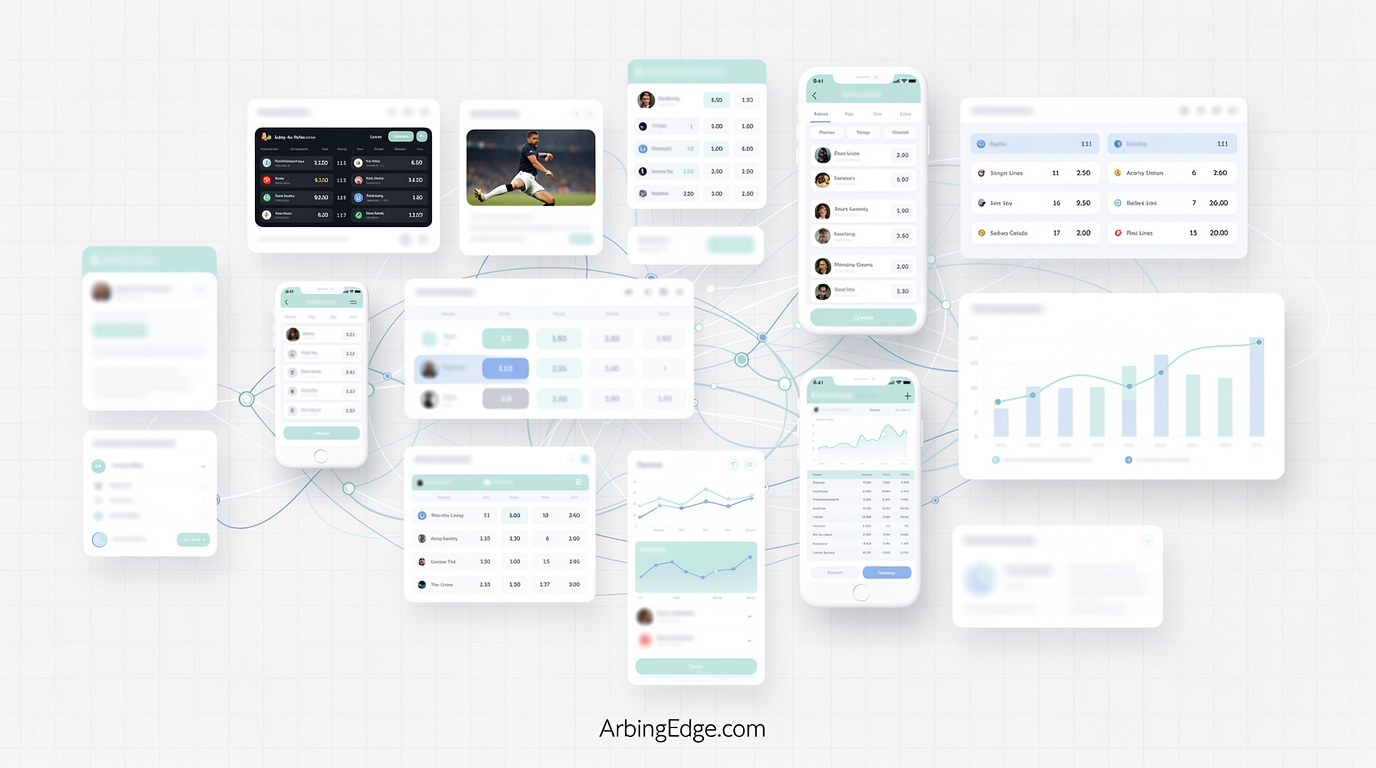
What API betting is and how automated sports betting works
API betting is placing bets programmatically through a platform's API instead of clicking through a website. Your software sends a place-bet request — market, selection, stake, price — to a broker, exchange, or sportsbook endpoint, and the platform executes it. This is what enables automated and agentic betting strategies: code (or an AI agent) can act on an opportunity the moment it appears.
This is deliberately different from an odds API, which only returns data — prices and arbitrage opportunities — and cannot place anything. Most automated setups use both layers: an odds or arbitrage feed to find the edge, and a betting API to place it. If you only need data, start with the odds API guide; if you need to automate placement, this page is the right one.
Be clear-eyed about the trade-offs. API betting requires real technical setup, it carries execution risk (latency, stale odds, partial fills) and terms-of-service risk, and the platforms involved are region-dependent — some are unavailable or restricted depending on where you live.
Automated sports betting API sites and how to use them
There are five practical routes to placing bets via API, grouped by platform type below. The simplest for most people is a Pro broker — one signup and one API key that reaches many books and exchanges, including the prediction-market and sharp-book venues that are otherwise hard to automate.
Automated sports betting API options by platform type
Five categories, from prediction markets to exchanges. Where a venue is reached through a broker, it is stated plainly — and availability varies by region throughout.
Prediction markets — Kalshi and Polymarket
PlatformsKalshi, Polymarket
Kalshi and Polymarket price real-world events as YES/NO contracts. Neither is designed for general automated sports-bet placement on retail accounts, but both can be reached programmatically for prediction-market arbitrage. This lets you route positions through a single integration instead of maintaining a separate connection to each venue. Availability is region-dependent; verify access for your jurisdiction before building.
Sports Betting Brokers
PlatformsMadMarket, SportMarket
Betting brokers route your stake into many high-limit sportsbooks and exchanges behind a single account and a single API. MadMarket and SportMarket are the two most relevant for automated betting: instead of integrating dozens of books individually, you place via the broker and it allocates to the underlying operators. Brokers are the simplest route to API betting at scale, but they are not available in every country — confirm eligibility first.
Crypto API Betting
PlatformsCrypto Sportsbook
Cloudbet is a crypto-funded sportsbook that exposes its own API for programmatic betting, so you can integrate directly without a broker. It suits bettors comfortable with crypto deposits and self-custody, and developers who want a direct place-bet endpoint. See the Cloudbet API for endpoints and limits. As with every option here, availability and crypto rules vary by region.
Sharp Bookmakers API
PlatformsPinnacle (via broker)
Pinnacle is the reference sharp book — low margins, high limits, and a winner-friendly stance. In most regions it is reached through a broker rather than a direct retail API, so automated Pinnacle betting typically runs via a broker connection. Pinnacle's own API access is limited and region-restricted, which is why the broker route is the practical path for most automated bettors.
Betting Exchanges API
PlatformsBetfair, BetDAQ, Betdex
Betting exchanges let you back and lay outcomes against other users, which is ideal for matched betting and lay-side arbitrage. Betfair offers a mature, well-documented API (an app key is required); BetDAQ provides an exchange API; and Betdex is a blockchain-based exchange with programmatic access. Exchange commission applies to net winnings (typically 2–5% per market, depending on the exchange and your rate). Exchange availability and API terms differ by country.
Get API betting access through a Pro broker platform
The simplest route to API betting across every site above is a Pro broker: one signup, one API key, many books and exchanges — including the Kalshi/Polymarket and Pinnacle routes.


All-in-one Arb Betting App
Bet on any of the sites above via API using this Pro broker platform.
- Single API to many high-limit books and exchanges
- The route to Kalshi & Polymarket and to Pinnacle via one connection
- High limits with a winner-friendly, no-quibble stance
- One signup, one API key — built for automated and agentic betting

Agentic-Friendly Arb App
Bet using DOM/Extension betting solution via browser using Arb Data.
- One account routes stakes into many sportsbooks and exchanges
- Single-Account access for agentic bet placement
- High-limit coverage aimed at sharp and professional bettors
- Programmatic-friendly for your own pipeline
Prefer to integrate a sportsbook directly? Cloudbet exposes its own crypto-funded betting API — a direct option if you don't want a broker. Brokers remain the simplest route for reaching many venues at once.
Arbitrage API packages: pair your data source with a betting site
Automated arbitrage is two layers: an API data source that finds the edge, and an API betting site that places it. Each package below is a ready-made pairing — follow it top to bottom.
Sports arbitrage
- Step 1 · Find the arb — API Data
Arbitrage Sports API Data
These two scanners provide API data for the sharp sportsbooks that brokers route to. Use either as the data layer that finds the arb.
- Step 2 · Place the bet — API Betting Site
Arbitrage API Betting Sites
Then place both legs through a broker. SportMarket reaches the high-limit and sharp books behind one API, so the arbs surfaced by either scanner can actually be bet automatically.
Prediction markets arbitrage
- Step 1 · Find the arb — API Data
Arbitrage Prediction Markets API Data
Markets Arb Finder provides arbitrage odds for Kalshi and Polymarket — both reachable through the broker platforms. It is the data layer that surfaces prediction-market mispricings in real time.
- Step 2 · Place the bet — API Betting Site
Arbitrage API Prediction Markets Sites
Place the prediction-market legs via a broker. SportMarket is the route to Kalshi and Polymarket through a single API, closing the loop from scanner data to an executed position.
How to set up API betting, step by step
-
Step 1 — Choose a broker or platform that fits your region
Start by picking where you can actually place bets via API. A Pro broker like SportMarket or MadMarket is the simplest route because one signup reaches many books and exchanges. Confirm the platform accepts users in your country before going further — region fit decides everything that follows.
-
Step 2 — Sign up and complete verification
Create your account and complete identity verification up front. Brokers and exchanges apply KYC and funding checks, and these can take time. Getting verified early means you are ready to build and test rather than waiting on approvals when you want to place your first automated bet.
-
Step 3 — Get your API key
Generate your API key (and any app key the platform requires, such as Betfair's) from your account dashboard. Treat the key like a password: store it in an environment variable or secret manager, never in client-side code or a public repo. The key authenticates every place-bet call you make.
-
Step 4 — Read the API docs and limits
Before writing code, read the platform's API documentation end to end: authentication, the place-bet endpoint, market and selection identifiers, minimum and maximum stakes, and rate limits. Understanding the limits now prevents your automation from being throttled or rejected at the worst possible moment later.
-
Step 5 — Connect your arb or odds source
Feed your placement system with opportunities. Connect an odds-data API (see our /api/ guide) or your arbitrage scanner so your code receives the markets, prices, and stake splits to act on. This is the data layer; the broker or exchange API is the execution layer that follows it.
-
Step 6 — Build the place-bet call
Write the function that turns an opportunity into a bet: map the market and selection to the platform's identifiers, set the stake and price, and submit through the place-bet endpoint. Start with a single, well-logged call you can run on demand before wiring it into any automated loop.
-
Step 7 — Validate in a sandbox or at minimum stake
Test the place-bet call in the platform's sandbox if one exists, or with the smallest real stake allowed. Confirm the bet lands on the right market at the right price, the response is parsed correctly, and your logs capture everything. Never let untested code place real money unattended.
-
Step 8 — Add error handling for the real failure modes
Automated betting fails in specific ways: stale odds that have already moved, partial fills where one leg lands and the other does not, suspended markets, and rate-limit rejections. Handle each explicitly — detect, retry where safe, and abort cleanly where not — so a failure never leaves you one-sided or over-staked.
-
Step 9 — Test the full loop with small money
Run the complete data → detection → placement → confirmation loop with live, small stakes. The goal is to see how it behaves with real timing and real money, not to earn. Watch fills, confirmations, and account health, and only treat the system as trustworthy once it holds up across many opportunities.
-
Step 10 — Scale gradually
Increase stakes and volume in steps, re-checking fills, limits, and account standing at each level. Automation amplifies both good and bad processes, so scale only what you have proven reliable. Remember the added terms-of-service, technical, and regional-legal risk grows with size — review the rules as you go. Nothing here is guaranteed.
API betting questions and answers
What is API betting?
API betting means placing bets programmatically through a platform's API, rather than clicking through a website. It lets you automate or run agentic betting strategies — your code submits the stake to a broker, exchange, or sportsbook endpoint. It is the bet-placement side of automation, distinct from an odds-data API that only returns prices.
How is API betting different from an odds API?
An odds API returns data — prices and opportunities — but cannot place a bet. An API betting platform actually executes the wager. Most automated setups use both: an odds/arbitrage API to find the opportunity and a betting API (often via a broker) to place it. See our /api/ guide for the data side.
Can I legally bet via API?
It depends entirely on your country and the platform. Some jurisdictions permit automated betting through licensed operators, brokers, or exchanges; others restrict or prohibit it. Brokers and exchanges are not available everywhere. Always confirm the legal status where you live and read each platform's terms before automating bet placement.
What is a betting broker and why use one?
A betting broker routes your stake into many sportsbooks and exchanges through a single account and API. Instead of integrating dozens of operators individually, you place once and the broker allocates. Brokers like SportMarket and MadMarket offer high limits and a single integration point, which is why they are the simplest route to API betting at scale.
Do I need to know how to code for API betting?
Yes. API betting involves authentication, reading documentation, mapping market identifiers, building a place-bet call, and handling failures like stale odds and partial fills. Without development skills it is impractical to build or maintain reliably. If you are not technical, manual arbitrage is the better starting point.
Which platforms have their own API versus access via a broker?
Cloudbet and exchanges like Betfair, BetDAQ, and Betdex expose their own APIs. Prediction markets (Kalshi, Polymarket) and sharp books like Pinnacle are typically reached through a broker such as SportMarket for automated betting. The broker route consolidates many venues behind one API.
How do I get an API key for betting?
Sign up with the broker, exchange, or sportsbook, complete identity verification, then generate the key from your account dashboard. Some platforms (e.g. Betfair) also require a separate application key. Store keys securely as secrets — never in client-side code — because the key authorises real bet placement.
Can I bet on Kalshi and Polymarket via API?
For automated betting, the practical route is the broker SportMarket, which is positioned to reach both venues through one API connection rather than integrating each separately. Both platforms also have their own developer interfaces, but availability and rules are region-dependent — verify access for your jurisdiction before building.
How do I bet on Pinnacle via API?
Pinnacle is the reference sharp book, but in most regions it is reached through a broker rather than a direct retail API. Automated Pinnacle betting typically runs via SportMarket or a similar broker connection. Direct API access to Pinnacle is limited and region-restricted, which is why the broker path is standard.
Does Betfair have a betting API?
Yes. Betfair offers a mature, well-documented exchange API that supports backing and laying programmatically, which makes it popular for matched betting and lay-side arbitrage. You need an application key and an account in an eligible region. Exchange commission applies to net winnings — factor it into any edge calculation.
What is Cloudbet and how does its API work?
Cloudbet is a crypto-funded sportsbook that exposes its own API for programmatic betting, so you can integrate directly without a broker. It suits users comfortable with crypto deposits and developers who want a direct place-bet endpoint. As always, availability and crypto regulations vary by region.
Will I get limited for betting via API?
On soft books, yes — profitable accounts get limited or closed regardless of how bets are placed. Brokers, sharp books, and exchanges are generally more tolerant of winners, which is part of their appeal for automated betting. Limiting is a commercial decision by the operator, not a legal one.
What does API betting cost?
Costs vary by platform: brokers may take a margin or commission, exchanges charge commission on net winnings, and crypto books embed costs in pricing and spreads. There may also be minimums and funding requirements. Read each platform's fee schedule before building, as fees directly reduce any theoretical arbitrage edge.
What are the main risks of automated betting?
The big ones are execution risk (latency, stale odds, partial fills that leave you one-sided), terms-of-service risk (automation may breach a platform's rules), technical risk (bugs placing wrong stakes), and regional-legal risk. Automation amplifies mistakes, so robust error handling and gradual scaling are essential. No outcome is guaranteed.
What is a partial fill and why does it matter?
A partial fill is when one leg of a two-sided bet lands but the other does not — for example, on an exchange where insufficient liquidity matches your lay. It leaves you exposed on one side instead of hedged. Detecting and handling partial fills is one of the most important parts of any automated betting system.
Do exchanges and brokers work for arbitrage?
Yes. Exchanges enable lay-side arbitrage and matched betting; brokers give high-limit access to many books for cross-book arbs. Routing one leg through an exchange or broker can reduce soft-book exposure. The key constraint is region availability and liquidity at the moment you need to place.
How fast does an API place a bet compared to manual?
Far faster — a well-built integration submits in milliseconds, which matters when arb windows close in seconds on liquid markets. But speed only helps if your data source, error handling, and the platform's rate limits all keep up. A fast place-bet call feeding on stale odds still loses.
Can AI agents place bets via API?
Technically yes — an agent can call a betting API the same way any program can, which is the basis of agentic betting. In practice you still need a legally available platform, secure key handling, and the same error handling and risk controls as any automation. The agent is just another caller of the place-bet endpoint.
How do I get started with API betting?
Pick a region-appropriate broker or platform, complete verification, get your API key, and read the docs. Connect an odds or arbitrage data source, build and validate a single place-bet call at minimum stake, add error handling, then scale gradually. Our setup guide and odds API guide cover the surrounding workflow.
Is API betting guaranteed to be profitable?
No. Arbitrage describes a theoretical margin under ideal conditions, and automation does not remove execution, ToS, liquidity, or legal risk. Odds move, bets can be voided or limited, and code can fail. This page is educational and is not financial or betting advice — only bet what you can afford to lose.