

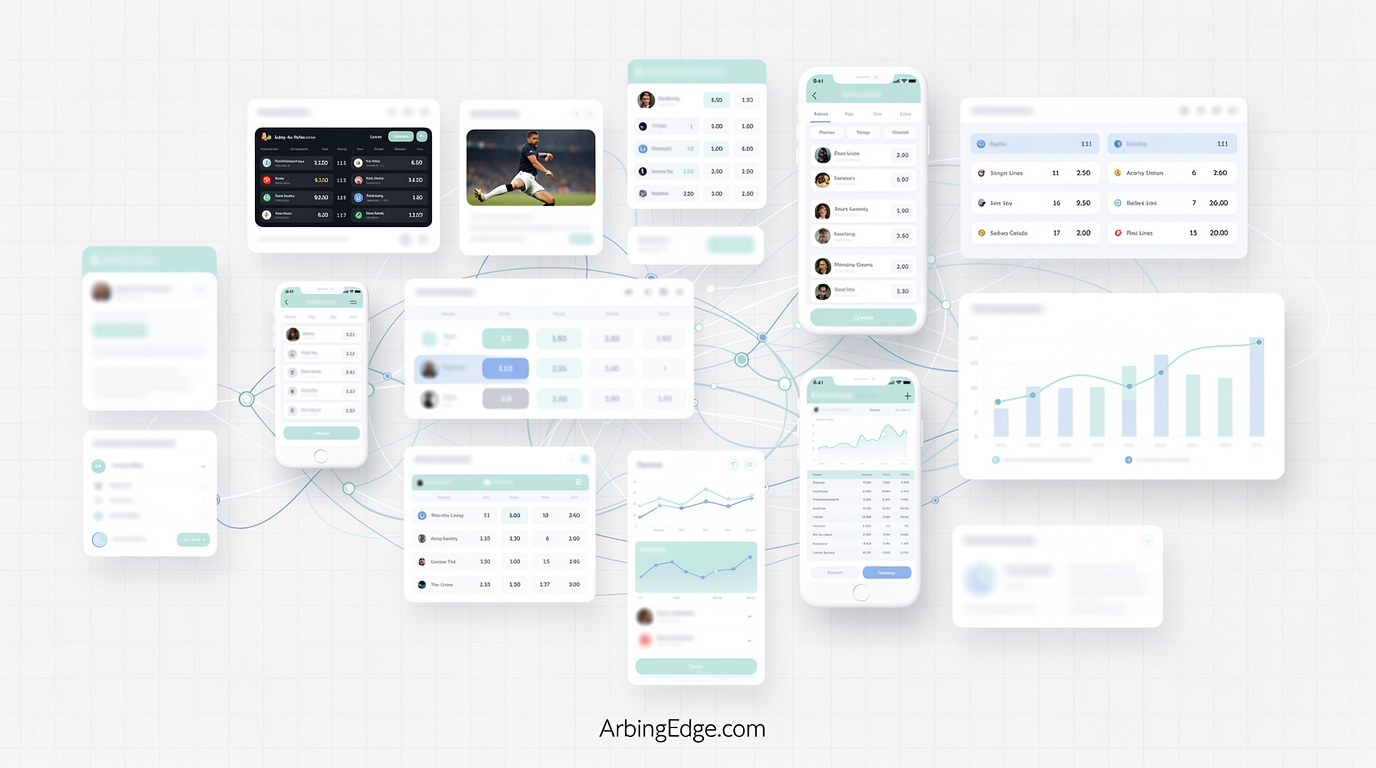
Key metrics across all API providers
What an arbitrage odds API is and where the data comes from
A structured data feed of live bookmaker prices — the raw material for every automated arb pipeline
An arbitrage odds API is a programmatic interface delivering real-time prices from many bookmakers in a normalised, machine-readable format.
It is the data layer every automated betting pipeline sits on. Your code polls an endpoint and receives structured JSON instead of scraping websites.
A typical response contains:
- Live odds across multiple bookmakers per outcome
- Normalised event identifiers, team names, and market types
- Detected arbitrage opportunities with stake splits and margins
Where the data comes from
Data originates from bookmaker price feeds — official partnerships or high-frequency scraping of public odds pages, depending on the provider.
Better providers normalise it, so "Arsenal v Chelsea" and "Chelsea vs Arsenal" resolve to the same event object across books.
Source type affects reliability:
- Feed-based — direct from bookmakers; lower latency, higher uptime.
- Scraper-based — depends on page structure; higher latency, occasional outages.
Most commercial APIs combine both. Verify source reliability and watch for data gaps during your trial.
How to use an arbitrage betting API: get data, then bet automatically
Eight stages — from raw odds ingestion to P&L reporting
Stage 1 — Get data
Poll the odds or arb endpoint on a defined interval, then write the normalised response into your own store — a database, edge function, or n8n/Make workflow.
Run detection against your store, not the live response. Filter by:
- Minimum margin — typically 1.5–2% net of fees
- Your allowed bookmaker list
- Sport and market type
This separation keeps your pipeline resilient to rate limits and outages.
Stage 2 — Normalise event names and odds format
API feeds from different providers express the same event differently. "Man City vs Arsenal" on one feed may be "Arsenal v Manchester City" on another. Your pipeline needs a normalisation layer that:
- Maps all odds to a single format (decimal is the universal standard for calculation)
- Resolves team/player names to a canonical identifier across providers
- Matches event start times to confirm both sides are for the same fixture
Without this, false arb signals appear — two different events accidentally matched because their names partially overlap.
Stage 3 — Resolve the exact bookmaker name and market identifier
Placing a bet programmatically requires the exact market identifier the bookmaker uses internally — not just the human-readable name.
This is a hard requirement for automated placement:
- Betfair uses market IDs like
1.234567890— your pipeline must store these, not just the event name - Most REST booking APIs require the bookmaker's own selection ID and market ID per bet leg
- Build a reference-data step that fetches current market IDs from each bookmaker before placement
An arb signal is useless if you cannot resolve it to a specific, placeable market at both books.
Stage 4 — Automate bet submission (DOM, agentic, or native API)
There are three practical automation approaches, ordered from lowest to highest implementation effort:
- DOM automation — control a real browser (Playwright, Puppeteer) to navigate to the bet slip and fill it in. Works on any bookmaker but is brittle to UI changes and slow.
- Agentic — an LLM-based agent receives the alert, resolves the market, and executes the placement steps as tool calls. Combines flexibility with the ability to handle edge cases.
- Native placement API — call the bookmaker's own API directly (available on Betfair Exchange, some Asian operators, and a handful of European books). Fastest and most reliable; not available everywhere.
Start with manual confirmation for the first month, then layer automation on top once the detection and normalisation steps are stable.
Stage 5 — Betslip submission and confirmation
Submitting a bet is not the same as confirming it. Your pipeline must handle all three execution channels and verify the outcome of each:
- Telegram alert — manual placement, fastest to set up. Send the formatted alert and confirm manually after placing.
- Webhook — route the signal into your app's notification layer or a downstream automation.
- Programmatic placement — call the bookmaker or exchange API and capture the response code, bet ID, and accepted odds before marking the leg as placed.
A submission without a confirmed bet ID should be treated as unplaced. Log every attempt — accepted, rejected, or timed out — so you can investigate failures.
Stage 6 — Confirmation awaiting: liquidity and acceptance checks
Even after submission, a bet can be refused or only partially filled. Your pipeline needs a confirmation step that checks:
- The bet was accepted in full at the submitted odds — not reduced or rejected
- Sufficient liquidity existed at the time of placement (relevant on exchanges where the lay side must be matched)
- Both legs of the arb are confirmed before treating the position as locked
If one leg is accepted and the other is rejected, the position is open (one-sided). Your circuit breaker should detect this and alert immediately for manual resolution.
Stage 7 — Profit confirmation after settlement
Once the event finishes, your pipeline should verify settlement automatically:
- Poll the bookmaker's results or settlement endpoint to confirm the winning leg paid out
- Cross-check the payout amount against the expected return calculated at placement time
- Flag any discrepancy (e.g. void bets, rule-4 deductions on horse racing) for manual review
Send a settlement notification — Telegram or webhook — with the confirmed profit amount so you have an auditable record independent of the bookmaker's interface.
Stage 8 — P&L reporting across all dimensions
A production arb pipeline generates enough data to run systematic performance monitoring. Track:
- By bookmaker — which books generate the most arbs, and where your account health is at risk
- By sport and market type — where your average margin is highest
- By time period — daily, weekly, monthly turnover and net profit
- Overall ROI — net profit as a percentage of total turnover, compared to your bankroll target
The bookmaker-level view is the most operationally important. It shows you which accounts are generating limiting pressure before you lose them entirely.
Arbitrage Odds API Providers
Five providers across US, international, sharp-line, AI-ready, and all-sports coverage
US Sportsbooks Arbitrage API
- Covers all major US state-licensed sportsbooks (DraftKings, FanDuel, BetMGM, Caesars and more)
- Live scanner + pre-match arb detection, positive EV signals
- REST JSON API, historical odds endpoint, event metadata for US sports
International Bookmakers REST API
- Global bookmaker coverage — European, Asian, exchange operators
- Surebets + middles detection in a single REST feed
- Bookmaker and sport reference endpoints for pipeline configuration
Sharp Betting Arbitrage API
- Only API delivering both surebets and Pinnacle-benchmarked value bets
- Historical performance endpoint for EV backtesting
- Global bookmaker coverage including Pinnacle as benchmark
AI-Ready Arbitrage Odds API
- 80+ bookmakers covered
- Normalised data model suited to AI agent and automation pipelines
- Broad market coverage for aggregators and multi-book monitoring
All Sports Arbitrage API
- Broad sports market coverage
- Programmatic arb detection feed, automatable and pipeline-friendly
- Designed for developers who need sports coverage beyond the major leagues
This guide compares five providers across US, international, sharp-line, AI-ready, and all-sports coverage, with full pipeline setup guides and honest notes on rate limits, pricing, and execution risk. Each card links to the detailed integration guide for that provider.
Arbitrage Odds API Finder Guide
-
Choose an API provider by coverage, latency and price
Start with market fit: a US-only bettor needs a US sportsbook API; a global bettor needs international bookmaker coverage; a quant building on AI pipelines may want the broadest bookmaker count or a normalised data model.
Check the rate limits and typical odds refresh cadence against your execution requirements before committing.
A sub-second latency API is only worth the premium if your strategy can act faster than a human.
-
Get your API key and read the rate limits before writing a line of code
Every provider issues an API key on the plan dashboard.
Read the rate limit documentation first — not after.
Rate limits on live odds can be as tight as one request per second.
Exceeding them results in 429 errors that break your pipeline at the worst moment.
Map your polling interval to the rate limit before building anything.
Pre-match data typically has looser limits than live in-play feeds.
-
Pull normalised odds into your own store
Polling a live API and acting on raw responses in real time is fragile.
The robust pattern is: poll the API on your chosen interval, write normalised odds rows into your own database or edge store (Supabase, PlanetScale, Cloudflare D1, or a simple n8n data store), and run your detection logic against your store rather than the live API response.
This decouples detection latency from network latency and gives you a queryable history for analysis.
-
Write the arb-detection logic — two sides under 100% after fees
An arb exists when the sum of the reciprocals of the best available odds across two books is less than 1.0 (i.e., implied probability sum under 100%).
In code: for each event, group odds by outcome, take the best price per outcome, sum the reciprocals, and flag any event where the sum is below your threshold (e.g., 0.985 to leave 1.5% net margin after fees).
This is pure maths — no provider-specific logic required.
Apply bookmaker and sport filters before the calculation to reduce compute.
-
Add a scoring and validation gate before acting on any signal
Not every detected arb is worth acting on.
Build a validation gate that checks: margin net of fees meets your minimum threshold, both sides are at bookmakers you currently hold accounts at, time-to-event is within your execution window, and the odds have not staled since the last poll (compare the timestamp on the API response against your store).
Discard any opportunity that fails any gate check.
A false positive costs more than a missed opportunity.
-
Wire instant notifications for app users — Telegram, Discord, or webhook
Once a signal passes your validation gate, deliver it fast.
For personal use: a Telegram bot message or a Discord webhook with a formatted card (bookmaker A + odds, bookmaker B + odds, margin, stake split at your standard size, event name and start time).
For SaaS products: a webhook to your user's endpoint or a push notification via your app's notification service.
Format for speed — users need to parse the alert and act in under 2 minutes on live markets.
-
Build the agentic loop: detect → score → notify → place
The agentic betting loop connects detection to execution.
After notification, the next step is placement: either manual-confirm (you receive the alert and click into each bookmaker) or programmatic (your system calls a placement API).
Most bettors start with manual-confirm.
Full automation requires bookmaker APIs — available on exchanges like Betfair and some international operators — and introduces execution risk: a partial fill if one side fills before the other.
Build manual-confirm first; add automated placement incrementally.
-
Add execution — manual confirm or fully automated placement
Automated placement via a bookmaker API is technically feasible on Betfair Exchange, some Asian operators, and a small number of European books.
US state-licensed sportsbooks do not offer public placement APIs.
For fully automated execution, your system places both legs simultaneously (or as close to simultaneously as possible), handles partial fills with a circuit breaker, and logs every placement attempt regardless of outcome.
Rate-limit your placement calls — bookmakers monitor account activity patterns and unusually fast sequential bets from a single account accelerate limiting.
-
Handle failures: stale odds, limits, partial fills, circuit breakers
Production arbitrage systems fail in predictable ways: odds go stale between detection and placement, one bookmaker rejects the bet (balance too low, market suspended, bet limit reached), or only one leg fills before the window closes.
Build explicit handlers for each failure mode: stale odds → discard and re-poll; rejection → log the reason code and skip that bookmaker for N minutes; partial fill → log the open position and alert immediately for manual resolution.
A circuit breaker that pauses the loop after N consecutive failures prevents compounding errors.
-
Package it as a SaaS feature — alerts, dashboards, or a managed feed
An arbitrage API pipeline is a product when it delivers value to others.
The SaaS angle: build a subscriber alert service (users receive Telegram/Discord alerts for arbs in their chosen markets), a managed data feed (deliver normalised arb data to other developers via your own API), or a white-label dashboard (a UI on top of your detection layer, branded for a niche market).
All three are possible on top of any of the five provider APIs in this guide.
Start with the smallest viable product — a Telegram bot for a single market — before building the dashboard.
Arbitrage Betting API Questions and Answers
What is an arbitrage betting API?
An arbitrage betting API is a programmatic data feed that delivers real-time odds from multiple bookmakers in a structured format.
Instead of monitoring a browser dashboard, developers poll the API to retrieve current prices and detected arbitrage opportunities.
The API handles bookmaker data collection and normalisation; you build detection, alerting, or execution logic on top of it.
What is the difference between a REST API and a streaming API for odds data?
A REST API requires you to poll a URL at regular intervals to fetch the latest data — you request, the server responds.
A streaming API (WebSocket or Server-Sent Events) pushes new data to your connection as it becomes available.
Most arbitrage odds APIs are REST-based polling APIs.
Streaming APIs exist but are less common and typically reserved for premium tiers.
How fast do arbitrage odds APIs refresh?
Refresh cadence varies by provider and plan tier.
Pre-match arb data typically refreshes every 30–120 seconds.
Live in-play data can refresh every 1–10 seconds on premium tiers.
The refresh rate is bounded by the API's rate limits — verify the maximum poll frequency for your chosen tier before building a time-sensitive pipeline.
What are API rate limits and how do they affect an arb pipeline?
Rate limits cap how many requests your API key can make per second, minute, or day.
Exceeding them returns a 429 error and may temporarily block your key.
For an arb pipeline, rate limits determine your minimum practical polling interval.
If your limit is 1 request per 30 seconds, you cannot reliably catch arbs that open and close in under 30 seconds.
Match your polling interval to your rate limit before building.
Which arbitrage API is best for US sportsbooks?
OddsJam's API, available at /api/us-sportsbooks/, is purpose-built for US state-licensed sportsbooks.
It covers DraftKings, FanDuel, BetMGM, Caesars, and US regional operators.
No other API in this comparison has the same depth of US market coverage.
Which arbitrage API is best for international bookmakers?
BetBurger's API, available at /api/international-bookmakers/, covers the broadest range of global bookmakers including European soft books, Asian operators, and exchanges.
It also includes a middles detection feed not available from US-focused providers.
Which API is best for Pinnacle sharp line data?
RebelBetting's API, available at /api/sharp-betting/, provides Pinnacle-benchmarked value betting signals alongside standard surebets.
It is the only API in this guide that delivers both guaranteed arbitrage margins and probabilistic EV signals from the same endpoint.
What is SportsGameOdds and why is it listed here?
SportsGameOdds provides an AI-ready arbitrage odds API covering 80+ bookmakers designed for developers and automated pipelines.
It is listed because its breadth of bookmaker coverage and normalised data model make it relevant to the Builder persona — developers building aggregators, AI agents, or multi-book monitoring systems who need raw odds data rather than pre-detected arbs.
What is Breaking-Bet?
Breaking-Bet provides an all sports arbitrage API covering a broad range of sports markets globally.
It is designed for developers who need programmatic arbitrage detection across sports that niche or US-focused APIs may not cover in depth.
Can you fully automate arbitrage betting with an API?
Yes, technically.
An automated pipeline detects arbs via API, calculates stakes, and places bets via bookmaker APIs without human intervention.
In practice, most bookmakers (especially US state-licensed sportsbooks) do not offer placement APIs.
Automation is most practical on exchanges like Betfair.
Full automation also accelerates account limiting — bookmakers flag systematic betting patterns.
Start with automated detection and manual placement before building fully automated execution.
Is arbitrage betting via API legal?
Using an API to detect arbitrage opportunities is not separately regulated in most jurisdictions — legality follows the underlying betting activity.
Where sports betting is legal, using software to detect price discrepancies is legal.
Where bookmakers' terms of service prohibit automated betting, breaking those terms risks account closure but is not a criminal offence.
Verify the terms of service of each bookmaker you plan to interact with programmatically.
How do I build an arbitrage pipeline with n8n?
n8n is a no-code/low-code automation platform that can poll HTTP endpoints, process JSON, and send notifications.
A basic n8n arb pipeline uses an HTTP Request node to poll your chosen API, a Function node to filter results by margin and bookmaker, and a Telegram or Discord node to send formatted alerts. n8n Cloud handles hosting; no server required.
This is the fastest path to a working pipeline for non-developers.
What does data normalisation mean for odds APIs?
Bookmakers use different formats, identifiers, and event naming conventions.
An API that normalises data maps all bookmakers to a common event ID, odds format (decimal), and outcome label.
Without normalisation, 'Manchester City v Arsenal' on Betfair might be listed differently than on Bet365, making automated comparison impossible.
All five APIs in this guide deliver normalised data — verify the normalisation depth (especially for niche sports) during your trial.
How do API fees interact with the raw arbitrage edge?
API subscription costs are fixed monthly overheads, not per-arb costs.
The relevant calculation is: (average daily arbs × average margin × daily bankroll deployed) × 30 days ≥ monthly API cost.
At 3 arbs per day on a $1,000 bankroll at 2% average margin, monthly gross is approximately $1,800.
Any API priced below 10% of that gross is not a meaningful cost driver.
Price the API subscription against projected volume, not against competing provider prices.
Do arbitrage APIs offer free tiers or trials?
Most providers offer a free trial period (typically 7–14 days) with full or limited API access.
Free permanent tiers are rare for commercial arbitrage APIs — the data collection infrastructure is expensive.
OddsShopper (not in this API guide, available in the tool reviews) is a permanently free web scanner, but it does not offer a developer API.
Verify current trial availability at each provider's site.
How do I handle stale odds in my pipeline?
Stale odds occur when the API response includes prices that have changed at the bookmaker since the last scrape.
Your pipeline should compare the timestamp on each odds row against your polling interval.
If the odds timestamp is older than 2× your polling interval, treat it as potentially stale and add a warning flag before acting.
For live markets, reject any opportunity where the odds timestamp is more than 60 seconds old.
Can I use webhooks instead of polling for arb alerts?
Some providers support webhooks that push new opportunity alerts to your endpoint as they are detected, eliminating the need to poll.
Webhook delivery is faster than polling but requires your endpoint to be publicly accessible and handle bursty traffic.
Check your chosen provider's documentation for webhook support — it is available on premium tiers at some providers and not offered at all by others.
Can I resell arbitrage API data I receive from these providers?
No, in most cases.
API provider terms of service typically prohibit redistributing or reselling raw data received via the API.
You may build products on top of the data (alerts, dashboards, aggregated signals) but the underlying odds data itself cannot be resold as a raw feed to third parties.
Read the terms of service for your chosen provider carefully before building a downstream data product.
How do I get started with an arbitrage API today?
Pick the provider that matches your market (US → us-sportsbooks, global → international-bookmakers, sharp/EV → sharp-betting, AI/multi-book → ai-ready-odds, broad sports → all-sports).
Start the free trial.
Read the API documentation and make a single authenticated test call before building anything.
Define your minimum margin, bookmaker filter, and polling interval.
Build the minimum viable pipeline first — poll, filter, alert — then add execution and logging.
What is the difference between a surebet API signal and an EV signal?
A surebet signal identifies a guaranteed profit regardless of outcome — both sides of the market sum to under 100% implied probability.
An EV (expected value) signal identifies a single bet that is priced more favourably than the true probability, but which can still lose.
Surebet signals produce certain but small margins; EV signals produce probabilistic returns that require a large sample to converge.
RebelBetting's API delivers both; the others focus on surebets.