

Key metrics
What an arbitrage betting tool is and how it works
From raw bookmaker odds to a guaranteed-margin alert — seven steps
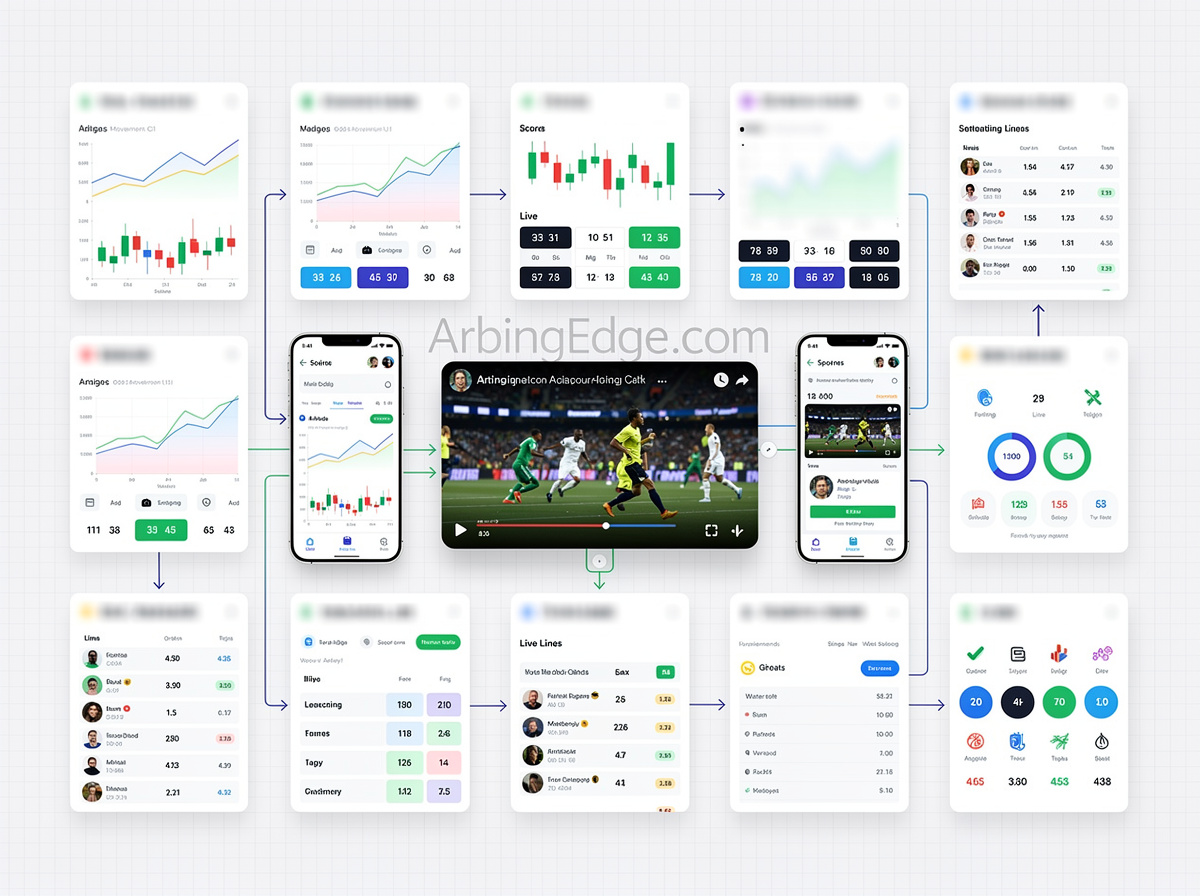
An arbitrage betting tool automates the process of finding guaranteed-margin bets across multiple bookmakers. Without a tool, you would need to monitor dozens of sites simultaneously, convert odds to implied probabilities, identify gaps, calculate stake splits, and act — all within a window that closes in minutes. A tool does the monitoring, detection, and calculation automatically, so you only intervene at the placement step. The seven-step process below is what happens from the time an arb forms to the time you lock the margin.
How an arbitrage betting tool works
-
The scanner ingests live odds from dozens of bookmakers simultaneously
An arbitrage tool connects to bookmaker odds feeds — either via official data partnerships or high-frequency scraping — and ingests current prices from every covered operator continuously. This is the data layer every other step depends on. Without it, you would need to manually monitor dozens of sites simultaneously, which is impractical at the speed markets move. The scanner does this automatically, around the clock, on every covered market.
-
Odds are normalised to a common format across all covered books
Different bookmakers express odds in different formats, use different team name conventions, and assign different internal event IDs. The scanner's normalisation layer maps all of this to a unified schema: decimal odds, a common event identifier, and consistent outcome labels. Without normalisation, comparing 'Arsenal v Chelsea' on Betfair against 'Chelsea vs Arsenal' on Bet365 would require manual mapping for every event. Normalisation makes automatic comparison possible.
-
The detection engine scans for price gaps across all covered outcomes
With normalised odds in hand, the detection engine runs the implied probability calculation on every event and market in real time: sum the reciprocal odds across all outcomes, and flag any event where the sum is below 1.0 (i.e., under 100% implied probability). This calculation runs continuously across hundreds of events and thousands of markets. The output is a list of current arb opportunities, sorted by margin size, refreshed every few seconds on live markets.
-
The stake calculator determines the exact bet for each side
For each detected arb, the tool calculates the optimal stake for each side given your total bankroll allocation. The formula allocates the total stake proportionally to the reciprocal of each side's odds, so that every possible outcome produces the same gross return. The output is two numbers: your stake on Side A at Bookmaker 1, and your stake on Side B at Bookmaker 2. Most tools display this in the alert, saving you the manual calculation step.
-
You receive an alert — in the browser, by push notification, or via API
The detected opportunity and its calculated stakes are delivered to you. Web-based scanners display alerts in the dashboard. Mobile-first tools like Sharp push notifications to your phone. API-connected pipelines deliver structured data to your own system. The delivery mechanism determines how fast you can act: push notifications allow you to start without opening a tab; API feeds enable fully automated routing without any manual monitoring at all.
-
You place both legs before the price window closes
With the alert and stake split in hand, you open both bookmakers simultaneously and place each bet at the stated price. The order of execution matters: start with the less liquid side (where price impact from your order is higher) before placing the larger or more liquid side. Confirm both bets before assuming the arb is locked. If one price has moved since the alert, recalculate the margin with the new price before proceeding. A closed window is a skip, not a loss.
-
Both sides settle and you collect the locked margin
When the event resolves, one bet wins and one bet loses. The net result across both bookmakers is your guaranteed margin — the percentage calculated at the time you placed the bets. The profit is deposited directly to your bookmaker balance. At scale: three arbs per day at 2% average margin on a $1,000 bankroll returns approximately $1,800 gross per month, independent of sporting results. The margin compounds as you reinvest profits into larger positions.
Betting Tools with Best Arbitrage Odds - compared, analyzed, reviewed
All 10 tools reviewed — find the right one for your market and bankroll
Top 3 arbitrage tools right now
OddsJam
Best for: US bettors who want live arbs and API access
- SportsNFL, NBA, MLB +9 more
- CountriesUS
- Live arbs✓ Yes
- Free trial✓ Yes
Outlier
Best for: US bettors new to arbitrage who want a simple interface
- SportsNFL, NBA, MLB +9 more
- CountriesUS
- Live arbs—
- Free trial✓ Yes
BetHero Sports
Best for: Bettors wanting an accessible entry-point arb tool
- SportsSoccer, Tennis, Basketball +9 more
- CountriesUS, GB, AU, CA, global
- Live arbs—
- Free trial✓ Yes
All arbitrage tool reviews
For side-by-side feature comparison (pricing, EV%, signal type), see the comparison hub →
| Tool | Sports | Countries | Free Trial | Full Details |
|---|---|---|---|---|
 | NFL, NBA, MLB+9 | US | Review Visit ↗ | |
 | Soccer, Tennis, Basketball+9 | global | Review Visit ↗ | |
 | Soccer, Tennis, Basketball+9 | global | Review Visit ↗ | |
 | Soccer, Tennis, Basketball+9 | global | Review Visit ↗ | |
 | Soccer, Horse Racing, Tennis+9 | GB | Review Visit ↗ | |
 | NFL, NBA, MLB+9 | US | Review Visit ↗ | |
 | NFL, Soccer, NBA+11 | US, GB | Review Visit ↗ | |
 | Soccer, Tennis, Basketball+9 | US, GB, AU, CA, global | Review Visit ↗ | |
 | NFL, NBA, MLB+9 | US | Review Visit ↗ | |
 | NFL, NBA, MLB+9 | US | Review Visit ↗ |
The percentage of arbitrage may vary by sport, bookmaker, timing, and market conditions. More bookmakers scanned = more pricing disagreements = higher-margin opportunities. Act quickly on any edge above 4% — those windows close fast.
Arbitrage software by market
Find the scanners that cover the bookmakers available where you are
Coverage is the first filter. A tool with 100 global bookmakers adds nothing if none of them are licensed in your jurisdiction. Use the Local Arbitrage hub to see which tools cover the sportsbooks you can actually open — filtered by country and sport.
Local ArbitrageUS · UK · Canada · Australia · Europe · Asia · Latin America · Africa
Compare arbitrage tools head-to-head
Side-by-side breakdowns across pricing, coverage, EV%, signal type, and more
The reviews table above shows which tools cover your market and sport. The comparison hub goes deeper: it runs five specific head-to-head matchups across eight dimensions — pricing relative to a $1,000 bankroll, average arb margin, signal speed, bookmaker coverage, limiting safety features, API availability, and a direct verdict on which tool wins for which type of bettor. If you have a two-tool shortlist, the comparison hub is your next stop.
Matchups available: OddsJam vs BetBurger, OddsJam vs RebelBetting, RebelBetting vs BetBurger, Arbamigo vs ProfitDuel, Sharp vs OddsJam. The full 8-column ComparisonTable covering all 10 tools in one view is also available.
Go to Comparison Hub →How to choose the right arbitrage betting tool for your bankroll
-
Start by listing your active bookmaker accounts
Coverage of your specific bookmakers is the most important filter. A tool covering 90 global operators is worthless if none of them are your books. Before comparing any feature, list the active accounts you hold — US state-licensed sportsbooks, UK-licensed operators, exchanges — and shortlist only tools whose bookmaker list overlaps significantly with yours. This single filter eliminates most of the field.
-
Set a bankroll target and calculate the minimum monthly return needed
At $1,000 bankroll and 2% average margin, three arbs per day returns roughly $1,800 gross per month. Any tool subscription under $180/mo costs under 10% of that gross — a rounding error. At $500 bankroll the same subscription costs over 20% of gross. Price your tool subscription as a percentage of projected monthly return, not as an absolute cost compared to another tool's price.
-
Match the signal delivery to your execution schedule
A live scanner that surfaces opportunities closing in two minutes is only useful if you can act in two minutes. Pre-match alerts that appear 48 hours before kick-off are viable if you check the tool twice a day. Mobile push notifications (Sharp) let you act without opening a browser. API feeds let you act without watching anything. Be honest about when you are available to place bets, and choose the delivery method that fits your schedule, not the one with the fastest refresh rate.
-
Decide whether you need US-only, global, or multi-market coverage
US-only tools (OddsJam, Outlier, Sharp) are purpose-built for state-licensed sportsbooks and will always have better US coverage than a global tool's US extension. Global tools (BetBurger, RebelBetting) cover European soft books, exchanges, and Asian operators. If you hold accounts in both US and international markets, you may need two subscriptions for maximum daily volume. Start with the market where you hold the most accounts.
-
Evaluate whether you need value betting signals alongside guaranteed arbs
Standard arbitrage requires placing both sides of a market simultaneously. Value betting identifies individual mispriced lines and requires only one placement — but the edge is probabilistic rather than guaranteed. RebelBetting and OddsJam both offer value betting signals alongside surebets. If you want dual-strategy capability, shortlist tools that include value betting in their plans. If you want pure guaranteed-margin arbs only, any scanner in this guide covers it.
-
Run free trials on your actual account list before paying anything
Every tool in this guide offers a free trial. Run two trials simultaneously if you have a shortlist of two tools — same period, same accounts. Count actual daily actionable opportunities — not the scanner's total alerts, but the ones that involve bookmakers you hold and at a margin that meets your threshold. The trial-period opportunity count is the single most reliable predictor of ongoing value. Do not pay for any tool before running this test.
-
Choose, commit, and scale from there
After trials, the decision is arithmetic: which tool, at its subscription price, produces the highest net monthly return given your specific bankroll and bookmaker list? Pick that tool, commit to consistent daily execution, and reinvest profits to grow your bankroll. The economics improve substantially as you scale — a $5,000 bankroll produces five times the absolute daily income at the same margin and the same subscription cost. Bankroll growth is the strategy.
Arbitrage betting tools — frequently asked questions
What is an arbitrage betting tool?
An arbitrage betting tool is a scanner that monitors bookmaker odds simultaneously, detects price gaps across multiple operators, and alerts you when a guaranteed-margin bet is available. It calculates the stake split across both sides automatically so you can act without doing the maths manually. Tools range from simple dashboards to full API feeds for automated pipelines.
Do I need an arbitrage tool to arb, or can I do it manually?
You can arb manually, but it is not practical at scale. Manual scanning requires monitoring dozens of sites simultaneously and calculating margins by hand — on liquid markets, arb windows close in under five minutes. A scanner automates the monitoring and flags only verified opportunities. Most active arbers use a tool within their first week of practice.
What is the best arbitrage tool for US bettors?
OddsJam is the most comprehensive US-market scanner with the widest US sportsbook coverage and a full API. Outlier is a strong alternative with a cleaner interface suited to beginners. Sharp is the best choice for bettors who primarily act on mobile. Run the free trial on your specific state's available books before committing.
What is the best arbitrage tool for UK or global bettors?
BetBurger and RebelBetting both cover global bookmakers including European soft books, Betfair Exchange, and Asian operators. RebelBetting adds Pinnacle-benchmarked value betting alongside surebets. Arbamigo is the best UK-specific option with dedicated horse racing and Betfair integration. The right choice depends on which books you hold.
Are there free arbitrage betting tools?
OddsShopper is a permanently free US arbitrage scanner. Most paid tools offer a 7–14 day free trial with full access. There is no permanent free option for global markets at the same capability level as paid tools. Use every available free trial before paying — the trial is the best predictor of ongoing value.
How many bookmakers does a typical arb tool cover?
US-focused tools cover 15–30 state-licensed sportsbooks. Global tools like BetBurger cover 50–100+ international operators. The count that matters is the overlap between the tool's covered books and the accounts you actually hold. A tool covering 100 books where you hold accounts at 5 is equivalent in practice to a tool with 15 books if the same 5 are included.
What sports do arbitrage tools cover?
All major tools cover soccer, tennis, basketball, and American football as primary markets. US-focused tools prioritise NFL, NBA, MLB, and NHL. Global tools add ice hockey, cricket, rugby, and other European and international sports. Niche sports coverage varies significantly — verify specific sport availability during the trial.
What is a live arbitrage scanner versus pre-match alerts?
A live scanner monitors in-play markets where odds change every few seconds and alerts you to arbs as they appear. Pre-match alerts identify arbs on events that have not yet started, typically hours or days in advance. Live scanners require fast execution; pre-match alerts suit bettors who check the tool periodically. Most tools offer both.
What does 'free trial' mean for arbitrage tools?
A free trial gives you full or limited access to the scanner for a set period — typically 7–14 days — without charging your payment method until the trial ends. Always use the trial on your actual bookmaker accounts to verify that the tool covers your books and generates actionable opportunities before committing to a paid subscription.
How do I know if an arbitrage tool is worth the subscription price?
During the free trial, count the number of daily actionable opportunities — arbs involving your specific bookmakers at a margin that meets your minimum threshold. Multiply that count by your average stake and margin to estimate monthly gross profit. If the estimated monthly gross is at least 10× the subscription price, the tool pays for itself. If not, the bookmaker coverage is not right for your setup.
Can I use two arbitrage tools at the same time?
Yes. Running a US-focused tool alongside a global one maximises daily opportunity volume if you hold both US and international accounts. The combined subscription cost should be recoverable against the incremental opportunities from the second provider. Run both trials simultaneously to measure the overlap — opportunities that appear on both tools are not doubled.
What is 'account limiting' and how do arb tools address it?
Account limiting is when a bookmaker reduces your maximum accepted stake because your betting is too profitable. It is legal and separate from whether arbing itself is legal. Tools do not prevent limiting — they find opportunities, not manage your relationship with bookmakers. Some tools include stake-rounding guidance to help you look less like an arber, which can slow the limiting process.
What is the difference between an arb scanner and a value betting tool?
An arb scanner identifies guaranteed-profit opportunities by finding markets where backing all outcomes across two books costs less than the total payout. A value betting tool identifies individual bets where the bookmaker's implied probability is lower than the true probability — each bet can lose, but the edge is positive over a large sample. Some tools (RebelBetting, OddsJam) include both in one subscription.
Do arbitrage tools work for in-play (live) betting?
Yes. Most tools offer a live scanner mode for in-play markets. Live arb windows are shorter — sometimes under 60 seconds — and require faster execution than pre-match arbs. For live arbing, choose a tool with a fast alert delivery method (push notifications or a fast-refresh dashboard) and confirm you can execute two bets quickly before starting.
What is the API feature and do I need it?
Some tools (OddsJam, BetBurger, RebelBetting) offer programmatic API access to their odds and arb data on premium tiers. The API lets you build custom alert pipelines, log opportunities to a database, or automate bet placement. If you are placing bets manually via the dashboard, the API adds no value and costs extra. It is relevant only for developers building custom systems.
Which arbitrage tools are best for beginners?
OddsShopper (free), Outlier, and Sharp are the most beginner-accessible US tools with straightforward interfaces. BetHero Sports is a clean entry point for international bettors. All offer free trials. Start with a tool that covers your bookmakers and has a clear alert format — you can always switch once you understand the workflow.
How many bookmaker accounts do I need before using an arb tool?
A minimum of three active bookmaker accounts is needed to see meaningful daily opportunity volume. More is better — most experienced arbers maintain 10–20+ accounts across their market. Open accounts before starting to arb, when you are a new customer with no limiting risk. The account-opening window is the most valuable time you will have; it does not return once you have been profiling as an arber.
Is my arbing income affected by which tool I use?
Your tool choice affects opportunity volume (which books are covered, how fast alerts arrive) and execution efficiency (how clearly the stake split is displayed). It does not affect the underlying margin percentage — that is set by the market. A better tool finds more opportunities; the same arb on the same books produces the same margin regardless of which scanner spotted it first.
Can I arb on mobile using these tools?
Sharp is the only tool in this guide with dedicated iOS and Android apps and push notifications for live arb alerts. All other tools are web-based and work in a mobile browser but are optimised for desktop. If you primarily bet on your phone, Sharp's mobile-first design is a meaningful practical advantage.
What is the typical average arb margin I can expect?
Average margins on mainstream markets (major sports, pre-match) typically run 1–3%. Niche markets and live arbs can produce higher margins but have shorter windows and lower liquidity. Your actual average will depend on which markets you focus on, your execution speed, and how long your bookmaker accounts stay unrestricted. Treat any specific margin figure as a starting estimate, not a guarantee.